



Weekly Bookkeeping Habits are pivotal just part of good hygiene for small businesses in Northern Colorado.
Bookkeeping often feels overwhelming because we imagine it as one giant project. In reality, it’s a series of very small decisions repeated consistently. Those decisions determine whether month-end feels manageable or stressful.
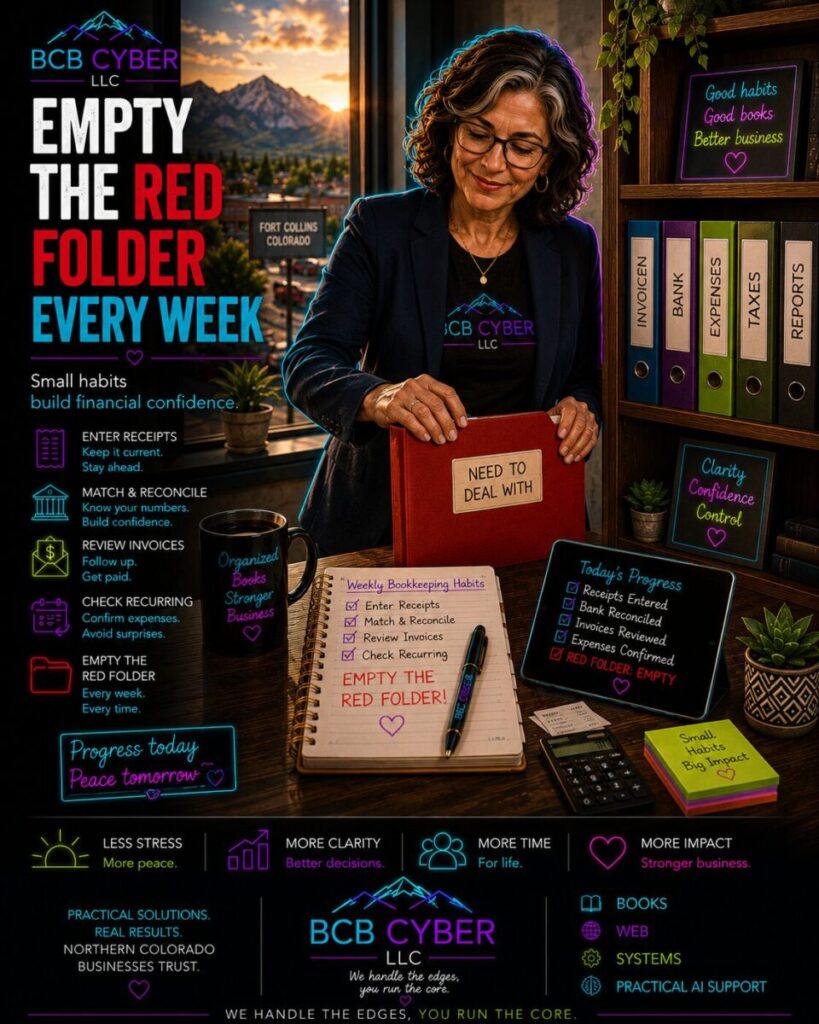
Rachel and the Red Folder
Wednesday mornings always began quietly in Rachel’s office.
Sunlight spilled through the large front windows overlooking a fictional Northern Colorado town square. A local coffee shop across the street had already filled with regulars, and cyclists rolled past flower-lined sidewalks on their way to work.
Rachel placed her coffee beside the familiar gray filing cabinet.
Next to it sat a single red folder. Unlike the neatly labeled binders surrounding it, the red folder had no permanent home. It was temporary by design.
Inside were the things that still needed attention. A missing receipt. A vendor statement waiting to be reconciled. A customer payment that hadn’t cleared. A question about an expense category.
Nothing urgent. Nothing dramatic. Just unfinished business.
Years ago, the red folder used to grow thicker every week.
Now Rachel had a rule: Never let it survive another Wednesday.
She opened it. Pulled out the first receipt. Matched it. Filed it. Next came the vendor statement. Reconciled. Filed. The customer payment. Confirmed. Filed. One by one, the folder became lighter.
Across town, Mason smiled when he received a quick message.
“Your bookkeeping question is resolved.”
Nina uploaded a receipt she’d almost forgotten. Sarah checked one recurring payment against her monthly budget. The little red folder connected more businesses than anyone realized.
By lunchtime, Rachel closed the folder. It was empty again.
She slid it back onto the shelf. Ready for next week.
Not because bookkeeping was finished forever. Because progress had become a habit.
Outside, the breeze carried the scent of fresh-cut grass through downtown as another summer morning settled into its familiar rhythm.
Rachel smiled. The folder would return. But it would never become overwhelming again.
Mini Guide
Five Wednesday Bookkeeping Habits
- Enter new receipts.
- Match bank transactions.
- Review outstanding invoices.
- Confirm recurring expenses.
- Empty your “red folder.”
Back to Rachel
Rachel never expected the red folder to disappear forever.
She simply refused to let it become a source of stress.
Every Wednesday, it became lighter. Every month, closing the books became easier. Consistency had quietly replaced anxiety.
Key Takeaway
The best bookkeeping habit isn’t catching up.
It’s refusing to fall far behind.
BCB Cyber, LLC
📊 Books • 🖥️ Web • ⚙️ Systems • 🧠 Practical AI Support
Embracing Tech on the Grind: We Handle the Edges, You Run the Core.
Frequently Asked Questions
Why does bookkeeping always seem to fall behind?
Bookkeeping usually doesn’t fall behind because it’s difficult. It falls behind because it competes with customer service, sales, scheduling, payroll, marketing, and dozens of other daily responsibilities. Small tasks that only take a few minutes are easy to postpone, but those small delays accumulate into much larger projects. Building a consistent weekly routine prevents bookkeeping from becoming overwhelming.
What is the “Red Folder” method?
The Red Folder is a simple organizational habit where every bookkeeping item that still requires attention is placed into one temporary location. Instead of scattered receipts, sticky notes, invoices, and reminders living across your desk or computer, they all have one home. The goal isn’t to eliminate the folder—it’s to empty it every week so unfinished work never becomes unmanageable.
How often should I update my bookkeeping?
Most small businesses benefit from reviewing their bookkeeping every week. Weekly updates make reconciliation easier, reduce forgotten transactions, improve cash flow visibility, and make month-end closing significantly less stressful. Waiting until the end of the month often turns a one-hour task into several hours of detective work.
How much bookkeeping should I do each week?
For many service-based businesses, setting aside 30 to 60 minutes once a week is enough to stay current. The exact amount depends on transaction volume, but consistency matters far more than long marathon sessions.
Why do missing receipts become such a problem?
Receipts are easiest to identify while the purchase is still fresh in your memory. Weeks later, it becomes much harder to remember what was purchased, why it was necessary, or which client it related to. Organizing receipts as they come in prevents unnecessary confusion later.
Is it really necessary to reconcile bank accounts every month?
Yes. Bank reconciliation helps verify that your accounting records match your actual financial activity. Regular reconciliation catches duplicate transactions, missing deposits, bank errors, and fraudulent activity before they become much larger problems.
What bookkeeping tasks should never be postponed?
Certain tasks have a tendency to snowball if ignored:
Entering receipts,
Categorizing expenses,
Recording customer payments,
Reconciling bank accounts,
Reviewing outstanding invoices,
Matching vendor statements, and
Filing payroll documentation
. Keeping these current dramatically reduces financial stress.
Can bookkeeping help me make better business decisions?
Absolutely. Clean financial records allow you to answer important questions quickly:
Which services are most profitable?
Are expenses increasing?
Which customers pay the fastest?
Is cash flow improving?
Can the business afford new equipment or employees?
Good bookkeeping transforms financial data into practical decision-making tools.
Should I keep paper receipts or scan everything?
Many businesses now benefit from digital receipt storage because it reduces physical clutter and makes searching much easier. Digital copies can also simplify tax preparation and disaster recovery. Regardless of your method, consistency is more important than format.