



Small business systems can have big impacts on an owner’s independence.
For many small business owners, time off is not really time off. The phone is still nearby. Customer messages still arrive. A team member still needs an answer.
Something still depends on the owner remembering where a file lives, how a process works, or what should happen next. That is not a failure of commitment.
It is a sign that the business needs more support around the person carrying it.
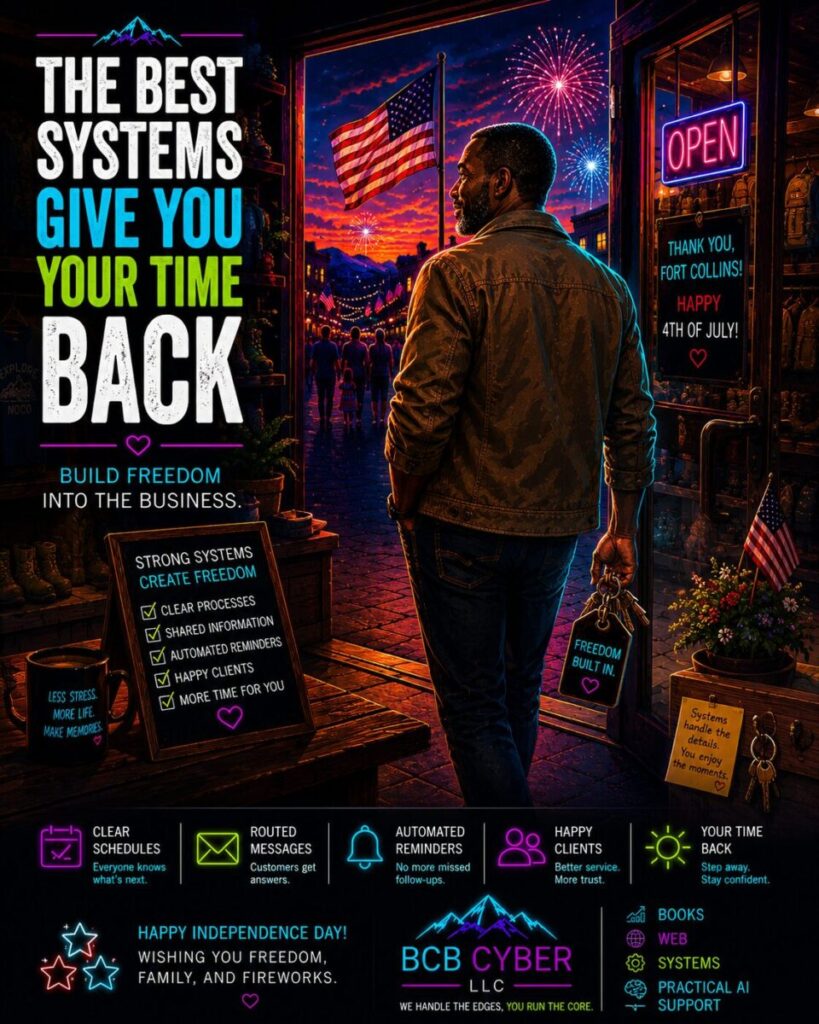
David and the Key Ring
By eight in the morning, downtown was already waking up.
American flags hung from the old brick storefronts along the Old Town main street, shifting gently in the July breeze. A few families had claimed curbside spots for the parade. Kids in red, white, and blue shirts chased each other past flower boxes while someone down the block tested a speaker for the afternoon music.
David stood outside his outdoor-goods shop with a ring of keys in his hand.
There were too many of them.
Front door. Back door. Storage room. Register drawer. Supply cabinet. Mailbox. A key for the small office upstairs. Another that he had not used in months but kept anyway because he could not remember what it opened.
He turned the ring over in his palm as the shop lights warmed up behind him.
For years, those keys had represented something he was proud of.
They meant he had built something real. A storefront. A customer base.
A place where hikers stopped in before heading toward the foothills, where parents picked up last-minute gear for family camping trips, and where locals came in for the kind of practical advice that could not be found on a product page.
But lately, the keys had started to feel heavier. Not physically. Mentally.
Every holiday, he tried to close early. Every holiday, he ended up answering messages from the parking lot. A customer needed a receipt. Someone asked whether an online order was ready. A vendor wanted an answer before Monday. One of the part-time staff members texted to ask where a pricing sheet was stored.
David always replied. Then he felt guilty for replying. Then he felt guilty for not being fully present with his family.
That morning, his daughter had asked whether he would make it to the fireworks before they started. He had said, “I’ll try.” The words bothered him all day.
Around noon, the parade began rolling through town. David watched from the shop doorway as a local marching band passed by, followed by a few decorated service trucks and kids waving small flags from a trailer covered in streamers.
His assistant manager, Andrea, stepped up beside him.
“You know we can handle the afternoon,” she said.
David looked back at the store. Everything was ready. The schedule was posted. The sale signs were updated. The register instructions were in one place. The online order list had been shared with the team. Customer questions were routed through the shop inbox instead of his personal phone.
For once, the business was not waiting for David to remember every detail.
He looked down at the keys again, then removed the old unused one from the ring.
Andrea smiled. “What was that for?”
David laughed. “Honestly? I have no idea.”
At four o’clock, he locked the front door, handed Andrea the closing checklist, and walked toward the parking lot.
The town was preparing for fireworks.
The foothills were turning gold in the long evening light. And for the first time in years, David did not leave wondering what he had forgotten.
He left knowing the business could keep moving without him for a few hours. That was not stepping away from responsibility. That was the result of building responsibility into the business itself.
Systems Create a Different Kind of Freedom
A good system makes work easier to find, understand, and complete.
That might mean:
- One shared calendar for appointments
- A documented opening and closing checklist
- Customer messages routed to a shared inbox
- Clear order and inventory procedures
- Automated reminders for common follow-ups
- A simple folder structure everyone can use
None of these changes are glamorous.
Together, they make a business more dependable.
Start With the “Four-Hour Test”
Ask yourself:
“If I stepped away for four hours, what would my business struggle to do without me?”
That answer may reveal:
- A process that only exists in your memory
- A customer question with no clear owner
- A missing checklist
- An outdated password process
- A workflow that needs automation
The goal is not to remove yourself from the business. It is to stop making yourself the only bridge between every moving part.
Freedom Requires Visibility
Team members cannot follow a process they cannot see. Customers cannot get reliable answers from information that only exists in one person’s head. Owners cannot relax when every problem routes back to them.
Visibility creates confidence. Confidence creates capacity. Capacity creates freedom.
Back to David
The fireworks did not begin until after dark.
David reached the park early enough to find his family, settle into a patch of grass, and watch the last light fade from the foothills.
His phone buzzed once. He looked at it. Then put it back in his pocket. The message was not urgent. The team had the checklist. The shop had the schedule. The business had a system.
For the first time in a long time, David was not standing outside the moment trying to manage it. He was part of it.
Key Takeaway:
A business is not truly independent until it can function without depending on you for every little thing.
BCB Cyber, LLC
📊 Books • 🖥️ Web • ⚙️ Systems • 🧠 Practical AI Support
Embracing Tech on the Grind: We Handle the Edges, You Run the Core.
Frequently Asked Questions
What are small business systems?
Small business systems are repeatable processes, tools, checklists, and workflows that help work get done consistently.
Why do business systems matter?
They reduce mental overload, prevent missed steps, and make it easier for owners and teams to stay organized.
Can systems help me take time off?
Yes. Clear systems help a business continue operating when the owner is unavailable for a few hours, a weekend, or longer.
What should I systemize first?
Start with the process that creates the most repeated interruptions or depends too heavily on your memory.
Do I need expensive software?
Not always. Many effective systems begin with clear checklists, shared calendars, consistent folders, and simple automation.
Can small businesses benefit from automation?
Absolutely. Appointment reminders, customer follow-ups, task notifications, and lead routing are common starting points.