


This week I came across a post from a custom jewelry maker.
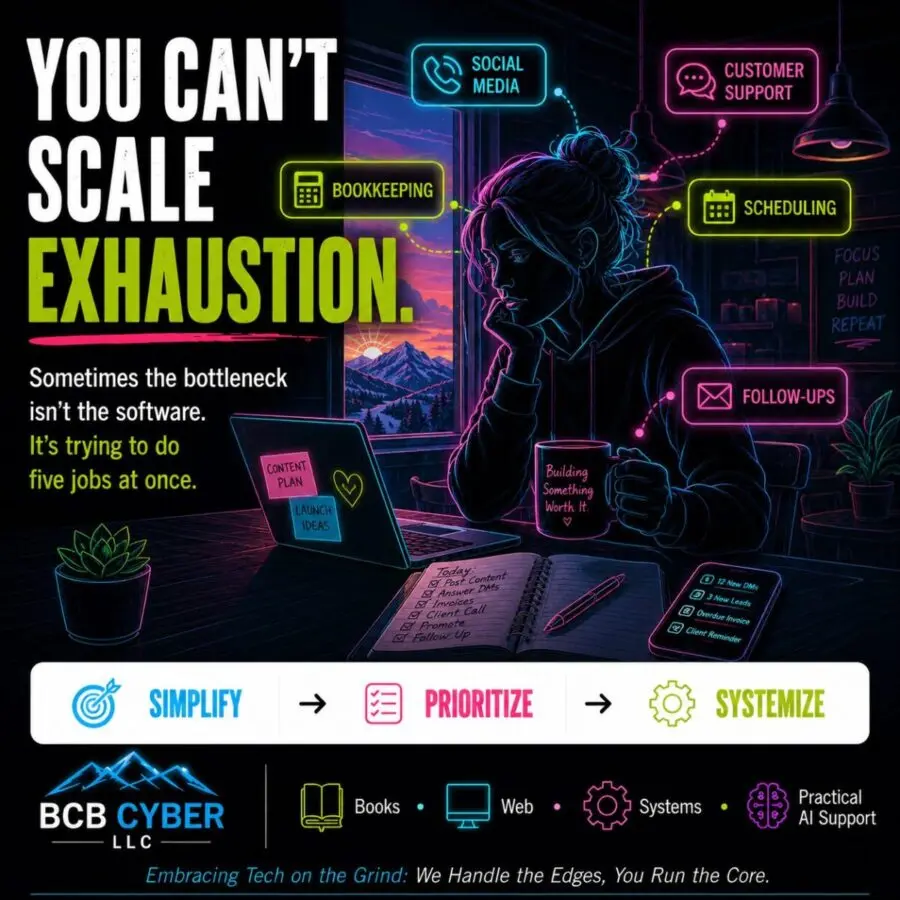
She was trying to juggle TikTok, Instagram, Facebook, YouTube, and LinkedIn. Not to mention keep on top of her bookkeeping, customer service, website health and growth, and oh yeah, running her business actually making the jewelry. She was doing this all by herself.
As I sat in a coffee shop watching the morning light hit the Front Range, I found myself thinking less about the software she was asking about and more about the situation she was describing.
Because it felt familiar.
The Question Was Simple
Our jewelry creator wasn’t asking about growth strategy. She wasn’t asking about branding. She wasn’t asking how to attract customers. She was asking:
“What social media scheduler should I buy?”
The comments filled up immediately. Metricool. Publer. MeetEdgar. RecurPost…
Everyone had a recommendation.
And some of those recommendations were probably good ones for her situation. But something about the conversation felt incomplete.
The Assumption Everyone Made
The assumption was that another tool would solve the problem.
And maybe it would help. But the more I thought about it, the more I realized the software wasn’t what caught my attention. The workload did.
Because this wasn’t really a story about scheduling. It was a story about capacity.
A Common Northern Colorado Business Challenge
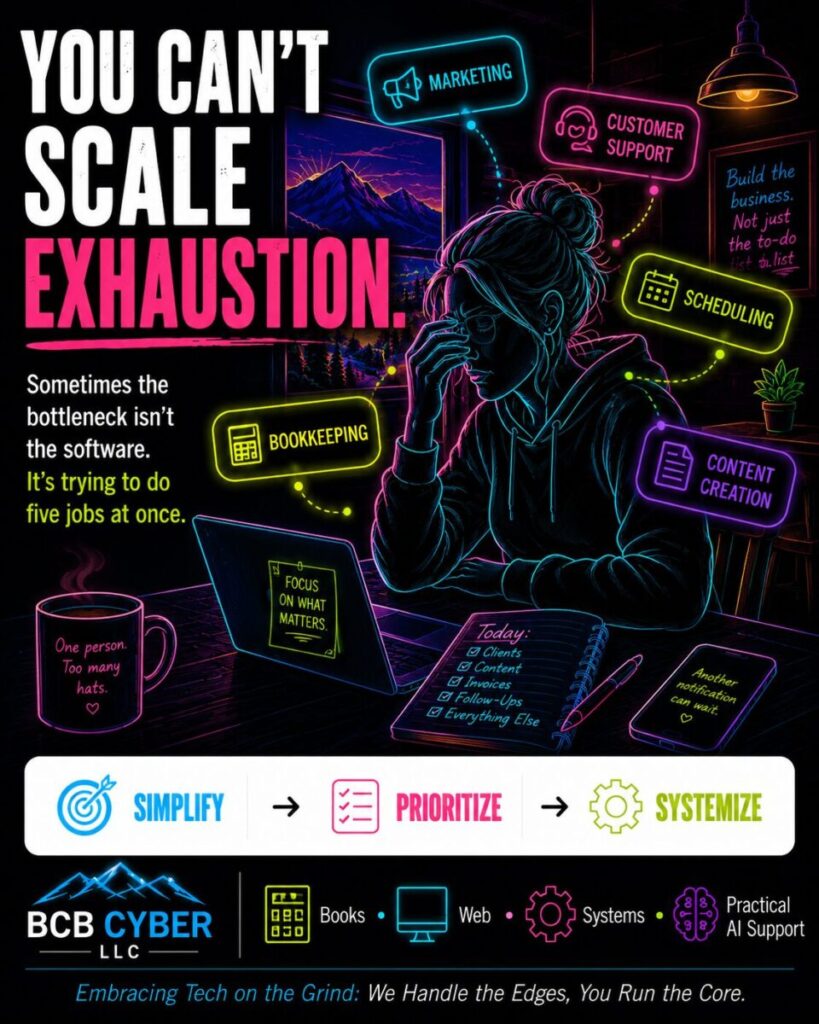
One pattern I’ve noticed among business owners across Northern Colorado is that growth often creates a strange paradox. The business improves. The workload expands. The owner becomes a marketer, a salesperson, a bookkeeper, primary customer support, an operations manager, and a content creator. All at the same time.
And while the business grows. The pressure grows with it.
When Tools Stop Helping
Tools are valuable. Systems are valuable. Automation is valuable. But none of them change a simple reality:
One person can only focus on so many things at once.
At a certain point, adding another platform can start feeling like adding another responsibility. Not another solution.
A Pattern We See In Growing Businesses
Whether it’s a wellness practice in Fort Collins, a contractor in Loveland, or a service business in Greeley, the pattern often looks similar. The owner becomes the answer to every problem. Every decision. Every task. Every customer interaction.
At first it feels necessary. Eventually it becomes exhausting.
Building BCB Cyber Has Taught Me This Too
One reason this story stood out is because it mirrors something I’m actively working through.
There are always websites to improve, content to curate, systems to document, outreach to complete and services to refine.
It’s easy to assume another tool is the answer. It’s harder to ask whether the real issue is simply trying to do too much at once.
The Real Bottleneck
The lesson isn’t that software is bad. The lesson isn’t that automation doesn’t help. The lesson is that not every bottleneck is technical.
Sometimes the bottleneck is human.
Sometimes the challenge isn’t efficiency.
It’s capacity.
Final Thought
As the coffee shop filled and the morning moved on, one idea kept sticking with me: You can scale systems. You can scale processes. You can scale technology. You can’t scale exhaustion. At least not for very long.
Eventually every growing business has to decide whether it’s building a business or simply building a larger list of responsibilities.
Tiny Framework for Today:
SIMPLIFY
↓
PRIORITIZE
↓
SYSTEMIZE
BCB Cyber, LLC
📊 Books • 🖥️ Web • ⚙️ Systems • 🧠 Practical AI Support
Embracing Tech on the Grind: We Handle the Edges, You Run the Core.
Frequently Asked Questions
What does “You Can’t Scale Exhaustion” mean?
It means that eventually business growth creates more responsibilities than one person can reasonably manage alone.
Can software solve business overload?
Software can help, but software alone cannot solve unrealistic workloads or poor prioritization.
Why do entrepreneurs feel overwhelmed?
Many entrepreneurs perform multiple roles simultaneously, including marketing, sales, operations, customer service, and administration.
Is adding another tool always the answer?
Not necessarily. Sometimes simplifying processes creates a bigger improvement than adding another platform.
What is a business bottleneck?
A bottleneck is any process, person, or constraint that limits progress or growth.
How do I know if I’m the bottleneck?
If important work stops when you’re unavailable, owner dependency may be limiting growth.
What’s the difference between being busy and being productive?
Busy focuses on activity. Productive focuses on meaningful outcomes.
Why do small business owners wear so many hats?
Limited resources often require owners to handle multiple functions during early growth stages.
When should a process be systemized?
When it becomes repetitive, predictable, and important enough to justify consistency.
What’s the biggest lesson from this story?
Not every problem requires a new tool. Some problems require a different approach to workload and responsibility.