

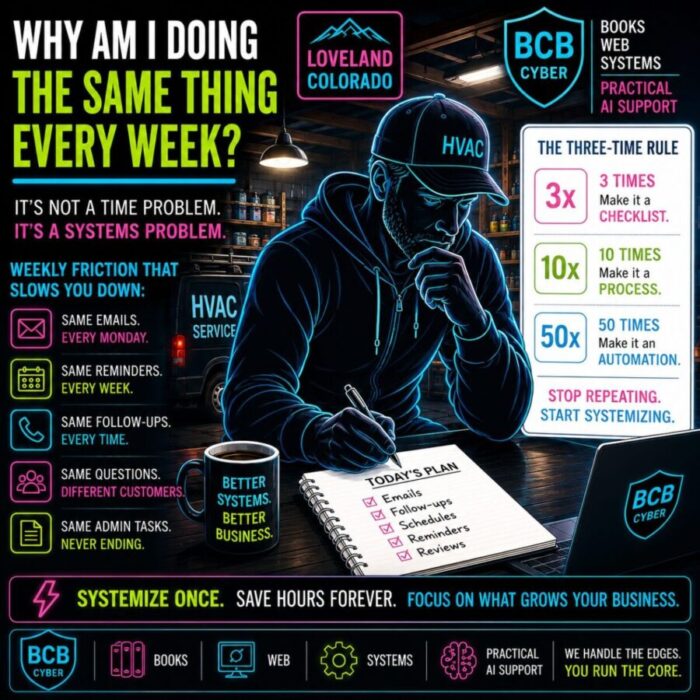

There is a moment that arrives for almost every business owner.
It usually happens late in the day. The truck is parked. The coffee is cold. The to-do list is open. And suddenly you notice something.
You’ve completed the same task again. The same follow-up. The same reminder. The same scheduling update. The same customer question. The same administrative chore.
Again.
The Notebook Test
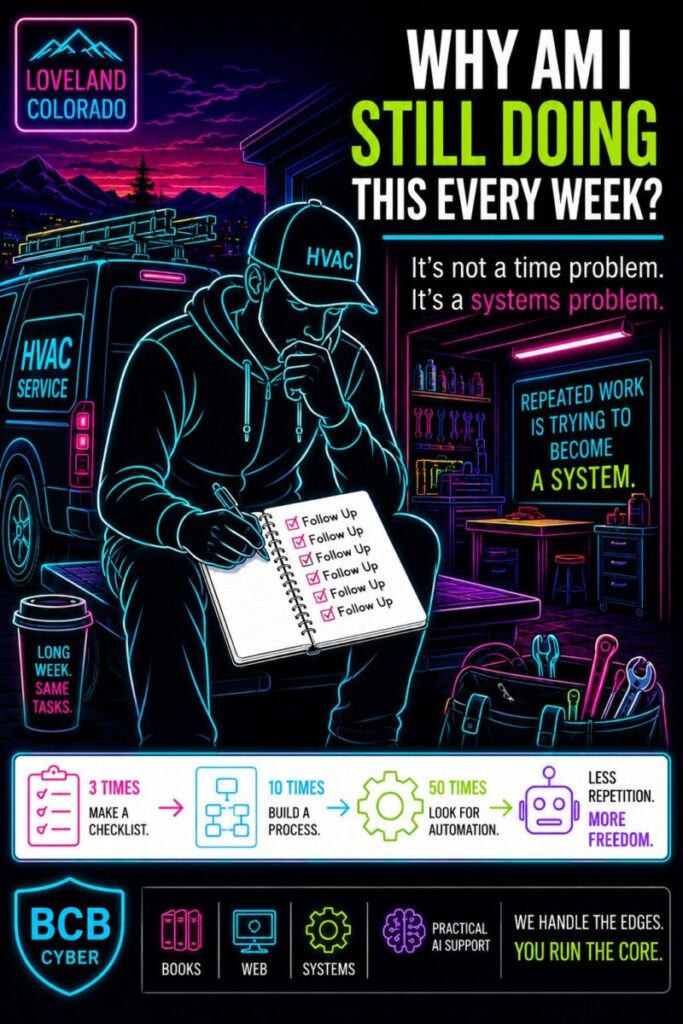
Imagine opening a notebook and flipping through the last six months. You discover page after page containing the same tasks. Not similar tasks. The exact same tasks.
At some point a reasonable person begins asking:
“Why am I still doing this manually?”
That’s not laziness. That’s awareness. And awareness is usually where systems begin.
A Lesson From Site Health
One of the recurring lessons from our own website work involved repeated operational checks. Review mobile performance. Check backups. Review plugins. Test forms. Monitor updates.
At first these felt like separate tasks. Eventually they became a checklist. The checklist reduced mistakes. The checklist reduced stress. The checklist created consistency.
That’s how systems are born.
The Three-Time Rule
A simple framework:
Three Times:
Create a checklist. If a task has happened three times, stop relying on memory. Document it.
Ten Times:
Create a process. Map the steps. Define the workflow. Make it repeatable.
Fifty Times:
Look for automation. At this point the task is likely consuming attention that could be spent elsewhere.
Automation Starts Earlier Than You Think
Many people hear the word automation and immediately imagine software, AI, or complicated integrations. In reality, automation usually starts much earlier. It starts with:
“There has to be a better way.”
Before software comes: awareness, documentation, consistency, and process. Technology simply amplifies what already exists.
Repetition Is A Clue
One of the biggest mindset shifts a business owner can make is viewing repetition differently. Repeated work isn’t necessarily the problem. Repeated work is information. It’s pointing at something: a future checklist, a future process, a future system, a future automation.
The task keeps returning because the business is trying to teach you where structure is needed.
The Goal Isn’t Efficiency
This surprises people. The goal isn’t really efficiency.
The goal is freedom.
Every system creates a little more space. A little less stress. A little less dependency on memory. A little more consistency. The time savings matter. The mental savings matter even more.
The Real Goal
The goal isn’t eliminating work. The goal is eliminating unnecessary repetition.
Because in our increasingly high-tech little future—where business owners are expected to manage marketing, customer service, operations, technology, and growth simultaneously—the organizations that thrive aren’t always the hardest working.
They’re the ones that build systems around what keeps showing up.
BCB Cyber, LLC
Books • Web • Systems • Practical AI Support
We Handle The Edges. You Run The Core. 🚀
What is a business system?
A business system is a documented and repeatable way of performing a task. Systems help create consistency, reduce mistakes, and save time.
When should I create a checklist?
If you’ve completed a task three or more times, a checklist can help ensure consistency and reduce mental workload.
What’s the difference between a checklist and a process?
A checklist helps ensure tasks are completed correctly. A process documents the complete workflow from start to finish.
When should I automate a task?
Tasks that are repetitive, predictable, and occur frequently are often good candidates for automation.
Do small businesses really need systems?
Yes. Systems reduce owner dependency, improve consistency, and make growth easier to manage.
Does automation replace people?
No. Good automation removes repetitive work so people can focus on higher-value activities.
What business processes are easiest to automate?
Common examples include appointment reminders, follow-up emails, review requests, lead nurturing, and status notifications.
What’s the biggest mistake business owners make with automation?
Trying to automate a bad process. The process should be documented and working before automation is introduced.
How do I identify automation opportunities?
Look for tasks you perform repeatedly every week. Repetition often points directly to automation opportunities.