



There is a funny thing about business.
People almost always see the result. They see the website. They see the completed project. They see the invoice. They see the polished process.
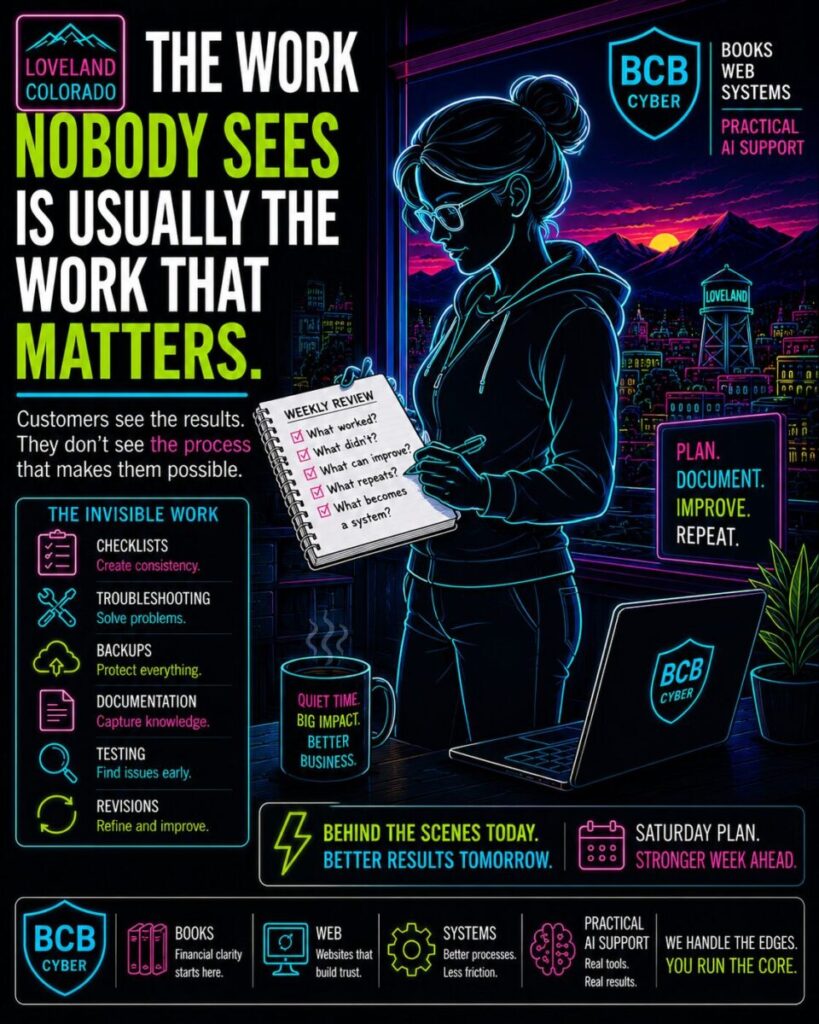
What they rarely see is everything that happened beforehand. The planning. The troubleshooting. The documentation. The review sessions. The mistakes. The revisions. The quiet work that made the visible work possible.
The Saturday Morning Advantage
Many business owners spend Monday through Friday reacting. Emails. Customers. Projects. Phone calls. Problems.
Then Saturday arrives. The phone slows down. The inbox quiets down. And for a brief moment there’s room to think.
That’s often where the biggest improvements happen. Not during the chaos. During the reflection.
The Work Behind The Work
One of the recurring lessons we’ve uncovered throughout recent BCB Cyber work is that every successful outcome usually has invisible support systems behind it.
A fast website? Someone reviewed performance.
Clean financial reports? Someone categorized transactions.
A smooth customer experience? Someone documented a process.
The visible result is rarely the whole story.
Friction Leaves Clues
Throughout this week we kept uncovering the same theme.
Wednesday: Financial uncertainty.
Thursday: Website hesitation.
Friday: Repeated manual work.
Different problems. Same root cause. Friction.
The challenge is that friction often hides inside ordinary routines.
A repeated question. A recurring mistake. A task that always takes longer than expected. Those small annoyances are usually clues.
The Weekly Review
One of the most valuable business habits is incredibly simple. Pause. Review. Ask questions.
What worked? What didn’t? What keeps repeating? What should become a checklist? What should become a process? What deserves attention before next week begins? These questions rarely produce dramatic breakthroughs. They produce something better. Steady improvement.
Why Documentation Matters
Documentation doesn’t feel exciting. Nobody wakes up eager to write procedures. Yet documentation creates something valuable: Consistency.
The moment a lesson gets written down, it becomes easier to repeat. The moment a process gets documented, it becomes easier to improve. The moment a system becomes visible, it becomes easier to scale.
Small Improvements Compound
Many people wait for a breakthrough. Most successful businesses grow through accumulation. One improvement. Then another. Then another.
Over time those small adjustments create a business that feels calmer, more predictable, and easier to operate.
The Real Goal
The goal isn’t perfection. The goal is progress.
Because in our increasingly high-tech little future—where owners are expected to manage technology, operations, marketing, customer service, and growth simultaneously—the businesses that improve consistently are often the ones that create time to reflect.
The visible work serves today’s customers.
The invisible work builds tomorrow’s business.
BCB Cyber, LLC
Books • Web • Systems • Practical AI Support
We Handle The Edges. You Run The Core. 🚀
Frequently Asked Questions
Why should business owners conduct a weekly review?
A weekly review helps identify recurring problems, opportunities for improvement, and lessons that can make future work easier and more consistent.
What is operational friction?
Operational friction is anything that slows down work, creates confusion, causes delays, or increases effort unnecessarily.
How much time should I spend reviewing my business each week?
Even 15 to 30 minutes can provide valuable insight. Consistency is often more important than duration.
Why is documentation important?
Documentation reduces reliance on memory, improves consistency, and makes processes easier to repeat, delegate, and improve.
What’s the difference between working in the business and working on the business?
Working in the business focuses on daily tasks and customer delivery. Working on the business focuses on improving systems, processes, and long-term performance.
Why do small problems become big problems?
Small issues often repeat unnoticed. Over time they create friction, waste time, and reduce efficiency if they aren’t addressed.
What should I document first?
Start with tasks that occur frequently or cause recurring confusion. Repeated tasks are usually the best candidates for documentation.
How do systems improve business growth?
Systems create consistency, reduce mistakes, save time, and allow owners to focus on higher-value activities.
What is the biggest benefit of a weekly review?
Clarity. The ability to step back, identify patterns, and make improvements before problems grow larger.