



Just before sunrise, Jake stood beside his truck overlooking the Northern Colorado foothills. Coffee in one hand. Phone in the other. He was reviewing yesterday’s activity before heading to his first jobsite.
Three new leads had been captured. Two appointments had been scheduled. A customer received answers after business hours. Nothing dramatic happened.
And that’s exactly what caught his attention.
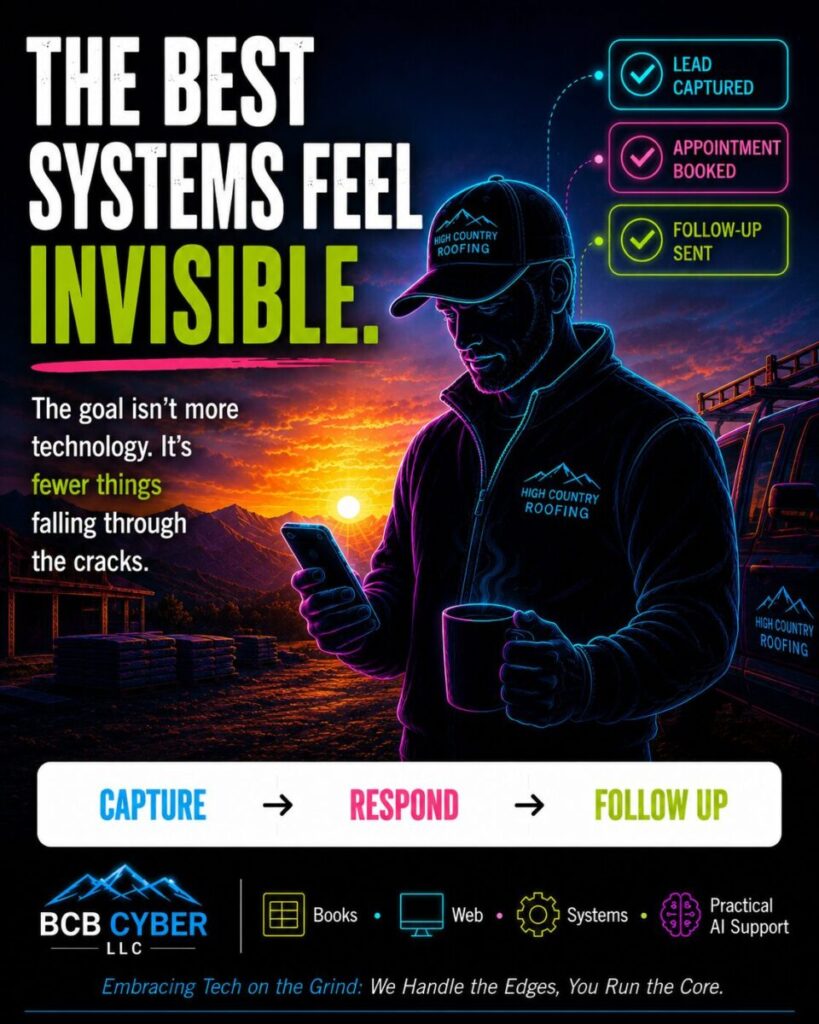
The Strange Thing About Good Systems
Most business owners only notice systems when they break. A missed phone call. A forgotten follow-up. An unanswered customer question. A lead that quietly disappears.
Failures create noise. Success usually doesn’t.
When systems are working properly, they often become invisible.
A Common Front Range Business Challenge
One pattern we’ve noticed across Northern Colorado service businesses is that owners often become the operating system of the company.
Every phone call. Every text. Every follow-up. Every scheduling decision. Every customer question. That works when the business is small.
But growth creates pressure. Eventually every opportunity depends on the owner’s availability. And that’s where friction begins.
Customers Don’t Care About Your Workflow
This is one of the most important lessons in operations.
Customers rarely care about: automation software, workflows, CRM systems, and integrations.
What they care about is the outcome. Did someone respond? Did they get an answer? Was scheduling easy? Did the business follow through?
The experience matters. The technology simply supports it.
Invisible Work Creates Visible Results
The strongest systems often do things nobody notices like capturing leads, sending reminders, creating follow-ups, scheduling appointments, and organizing information.
None of those tasks feel exciting. But they create consistency. And consistency creates trust.
A Pattern We See Across Northern Colorado
Whether it’s a contractor in Loveland, a wellness practice in Fort Collins, or a service company in Greeley, one issue appears again and again:
The owner becomes the bottleneck.
Not intentionally. Simply because too many things depend on them personally.
The businesses that grow most smoothly usually find ways to create systems that continue working when the owner is busy.
The Four-Hour Test
Here’s a simple exercise. Ask yourself:
What happens if I don’t answer my phone for four hours?
The answer often reveals more about your business systems than any software report ever could. Would opportunities continue moving forward? Or would everything stop and wait?
The Real Purpose Of Systems
Many people think systems exist to save time. That’s part of it.
But the bigger purpose is reliability. Customers shouldn’t receive great service only when the owner happens to be available.
Strong systems help create a consistent experience every time.
Final Thought
As Jake finished his coffee and headed toward his first appointment, he realized something. The reason yesterday felt smooth wasn’t luck. It wasn’t extra effort. It wasn’t working longer hours. The systems simply did their job.
And the strongest systems often do exactly that. Quietly. Consistently. Without needing attention.
Tiny Framework:
CAPTURE
Don’t lose opportunities.
RESPOND
Create confidence.
FOLLOW UP
Keep momentum moving.
BCB Cyber, LLC
📊 Books • 🖥️ Web • ⚙️ Systems • 🧠 Practical AI Support
Embracing Tech on the Grind: We Handle the Edges, You Run the Core.
Frequently Asked Questions
What makes a business system effective?
An effective system consistently produces the desired outcome without requiring constant oversight.
Why do small businesses need systems?
Systems help reduce missed opportunities, improve customer experience, and create consistency as the business grows.
What’s the difference between a process and a system?
A process describes the steps. A system ensures the steps happen consistently.
Do systems replace employees?
No. Strong systems support employees and owners by reducing repetitive work and improving consistency.
Why do missed follow-ups happen?
Many businesses rely on memory and manual tracking, which becomes difficult as activity increases.
How can automation help small businesses?
Automation can help capture leads, send responses, schedule appointments, and maintain follow-up consistency.
What is an AI Receptionist?
An AI Receptionist helps answer questions, capture leads, schedule appointments, and assist customers when staff are unavailable.
How do I know if my business needs better systems?
If opportunities depend entirely on you being available, there is usually an opportunity for improvement.
What’s the biggest systems mistake small businesses make?
Allowing the owner to become the system.
What is the goal of automation?
The goal isn’t replacing people. It’s creating reliable customer experiences and reducing operational friction.