



Business Process Improvements
Some of the most expensive business problems are not broken enough to demand attention. The work still gets completed. Customers still receive service. Employees still find a way forward. Because the process technically functions, everyone learns to tolerate the inconvenience.
That is how workarounds become embedded inside a business.
Over time, the extra click, repeated entry, unnecessary approval, or manual reminder becomes part of the routine. New employees are trained to follow it. Experienced employees become highly skilled at compensating for it.
The business may never calculate the cost. But it pays anyway—in time, attention, mistakes, stress, and reduced capacity.
Today’s story about Carlos and the dragging gate illustrates a practical truth: A familiar workaround is not the same as a dependable system.
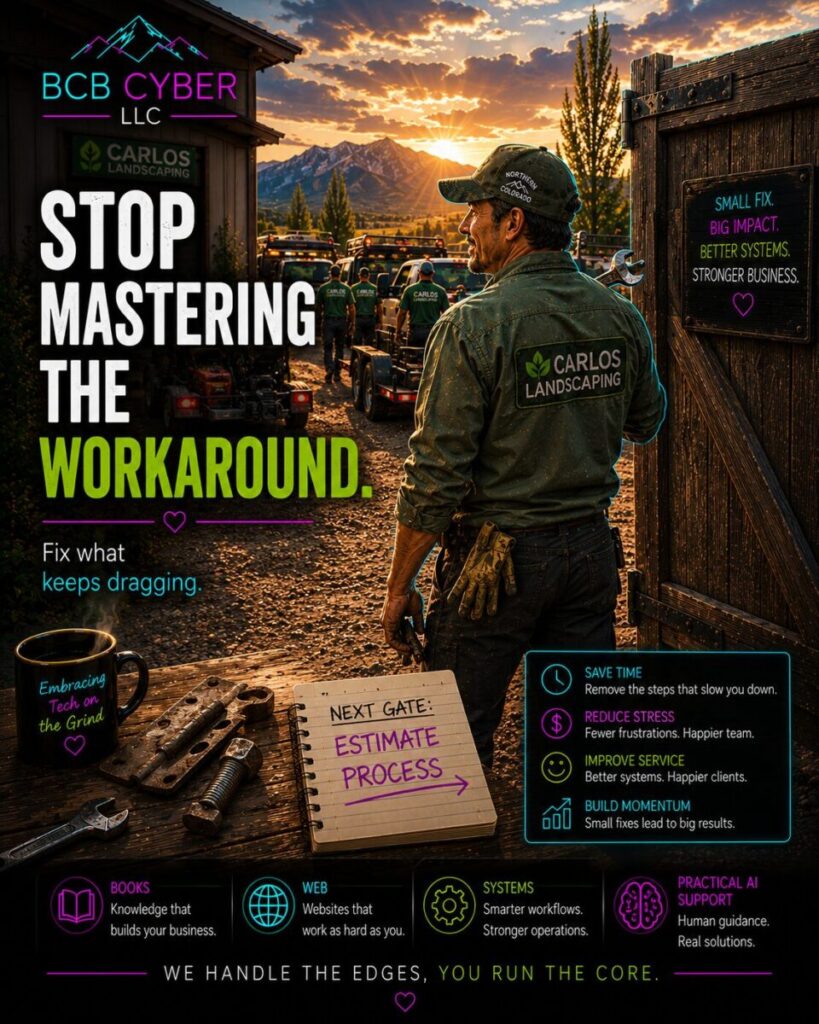
Today’s Story: Carlos and the Gate That Dragged
Carlos arrived at the equipment yard before the sun cleared the eastern horizon.
The air still held a trace of the coolness that would disappear by mid-morning. Irrigation water moved through a shallow ditch beside the property, and sprinklers clicked across the grass surrounding the nearby office park. Farther west, the foothills stood dark against a pale July sky.
His crew would arrive in twenty minutes.
Carlos carried his coffee toward the wide wooden gate separating the yard from the alley. Behind it, three trucks and two trailers waited for the day’s routes.
He unlocked the chain, pulled the gate toward himself, and felt the familiar resistance. The lower corner scraped across the gravel.
Carlos lifted with one hand and pulled with the other.
The gate moved. It always moved. You simply had to know how.
When the first employee arrived, Carlos held the gate up while the truck rolled through.
“Still fighting that thing?” the driver asked.
Carlos laughed.
“It keeps me strong.”
The joke had become part of the morning routine.
Everyone knew the procedure. Lift the corner. Pull slowly. Watch the bottom hinge. Do not let it swing too far.
A newer employee had once tried to open it normally and nearly pulled the latch board loose. After that, Carlos showed every new hire the correct workaround.
By seven, all three crews had left.
Carlos closed the gate using the same careful motion and returned to the office. The morning filled quickly.
A customer wanted to change a service date. A supplier called about delayed mulch. One crew needed clarification about an irrigation repair. Another sent a photo of a damaged sprinkler head.
Shortly before lunch, Carlos walked back outside to meet a delivery driver. The driver stopped beside the gate and watched Carlos lift the dragging corner.
“You know that hinge is loose, right?”
Carlos looked at it. He knew. Of course he knew.
The bolts had slowly pulled away from the post, allowing the gate to sag just enough to scrape the ground.
“I keep meaning to get to it,” Carlos said.
The driver nodded toward the truck. “I’ve got a wrench.”
Ten minutes later, they had tightened the hinge plate, replaced one damaged bolt, and adjusted the latch.
Carlos pushed the gate. It swung open silently. He pulled it closed. No lifting. No scraping. No special technique.
He opened it again, almost suspicious of how easily it moved.
The delivery driver smiled. “There you go.”
Carlos stood beside the gate after the truck left. For months, he had lifted that corner several times every day. His crew had done the same. He had trained new employees to work around it. He had warned people not to pull too hard.
The fix had taken ten minutes and it was something he already knew how to do. That afternoon, the crews began returning.
The first driver reached the gate, stepped out of the truck, and automatically bent to lift the corner.
He paused. The gate moved freely.
“What happened?”
Carlos pointed at the hinge.
“We stopped getting good at the workaround.”
By the time the last trailer rolled into the yard, the western sky had darkened with a typical summer thunderstorm. Wind moved through the cottonwoods, and the smell of rain crossed the gravel lot before the first drops fell.
Carlos closed the gate with one hand. The change seemed small.
The gate had never stopped the business from operating. Customers had still received service. Crews had still reached job sites. Revenue had still come in.
But every morning had begun with unnecessary resistance. Now it didn’t.
As Carlos locked the latch, he thought about the other “gates” inside the business. The estimate template that required copying the same details twice. The schedule that lived in two different places. The supply request process that depended on text messages.
None of them were catastrophic. They simply dragged.
Tomorrow, he decided, he would choose one. Not to work around. To fix.
Hidden Friction Inside Everyday Business Processes
Operational friction is any repeated obstacle that consumes time or energy without creating meaningful value. It rarely announces itself as a major failure.
Instead, it becomes visible through small moments:
- Employees copying information between systems
- Owners repeatedly answering the same internal questions
- Staff searching for files or passwords
- Customer requests being manually routed
- Forms requiring unnecessary fields
- Reports being rebuilt from scratch
- Approvals waiting on one person
- Teams relying on text messages to manage important work
The process may still produce the expected result. The problem is how much effort is required to reach it.
Consider a customer inquiry that arrives through a website form.
In a streamlined process, the information might automatically enter a central system, notify the correct employee, create a follow-up task, and preserve the original details.
Hidden friction matters because it multiplies.
A three-minute workaround repeated ten times a day consumes more than twelve hours in a typical working month. When several employees follow the same process—or several inefficient processes exist at once—the loss becomes substantial.
The time cost is only part of the problem.
Repeated friction also increases:
- Mental fatigue
- Training difficulty
- Inconsistent service
- Employee frustration
- Delayed responses
- Data-entry errors
- Dependence on specific individuals
A business can remain busy while quietly losing capacity through preventable friction.
Why Workarounds Become Permanent
Most inefficient processes did not begin as bad ideas.
They began as temporary solutions. A spreadsheet was created because the main system lacked one field. A text-message group was started because the team needed a quick answer. A paper checklist was added because the software notification was unreliable. A second tool was purchased to solve an urgent problem.
Each decision may have been reasonable at the time. The issue appears when the temporary solution remains long after the original circumstances have changed. Workarounds become permanent for several reasons.
Familiarity feels efficient
Employees know what to do, even if the process requires unnecessary steps. Changing it may initially feel slower because people must learn a new method.
The problem is distributed
No single repetition feels costly enough to justify attention. The total impact remains hidden across hundreds of small interactions.
The process has an owner—but no reviewer
Someone keeps the process functioning, but nobody is responsible for evaluating whether it still makes sense.
The workaround protects against uncertainty
Businesses often keep redundant steps because they do not fully trust the primary system.
Everyone assumes someone else designed it intentionally
Employees may follow a process for years without knowing why it exists.
A useful operational question is:
What would happen if we removed this step?
When nobody can clearly explain its purpose, the step deserves examination.
Why Simplicity Outperforms Constant Compensation
Strong systems reduce the amount of special knowledge required to complete routine work. That does not mean removing judgment, expertise, or human service. It means ensuring the process does not depend on unnecessary memory or improvisation.
A simple process is easier to:
- Teach
- Repeat
- Measure
- Improve
- Delegate
- Automate
- Recover when someone is absent
Simplicity also improves customer experience.
Customers do not see the internal workflow. They experience its results:
- Faster answers
- Fewer mistakes
- Clearer communication
- Reliable appointments
- Consistent follow-up
- Less need to repeat information
Complexity sometimes creates the appearance of sophistication. But a process is not valuable because it has many steps, dashboards, or tools. It is valuable because it produces a dependable outcome with reasonable effort.
The best systems often feel almost invisible.
The information is where employees expect it. The next step is clear. The customer receives a response. The task moves forward.
Nobody has to lift the corner of the gate.
Five Signs Your Business Has a “Dragging Gate”
1. Employees teach one another unofficial tricks
Statements such as “You have to click this first,” “Ignore that notification,” or “Ask Maria because she knows how” indicate that the documented process does not match reality.
2. The same information is entered more than once
Duplicate data entry is one of the clearest signs that tools or workflows are disconnected.
3. One employee is required for routine work to continue
Expertise is valuable. Dependence is risky. If a normal process stops whenever one person is unavailable, the workflow needs better documentation or design.
4. Employees repeatedly complain about a small task
Recurring frustration should not be dismissed merely because the task appears minor. Frequency can make small problems expensive.
5. The workaround takes longer to explain than the desired outcome
When training focuses more on avoiding process failures than completing the actual work, the system is creating unnecessary complexity.
Where to Start This Week
Do not begin by trying to repair the entire business. Choose one “dragging gate.”
Look for a process that:
- Happens frequently
- Creates visible frustration
- Requires a workaround
- Depends on memory
- Produces repeated questions
- Touches customers or revenue
Write down every step exactly as it happens today.
Then evaluate each step using four questions:
- Why does this step exist?
- What value does it create?
- What risk would appear if we removed it?
- Could the outcome be achieved more simply?
Speak with the people who perform the work. They often understand the friction better than the person who originally designed the process.
Then make one controlled improvement.
Examples include:
- Replacing duplicate spreadsheets with one shared source
- Creating an automated notification
- Standardizing a file location
- Removing an unnecessary approval
- Building a reusable template
- Documenting a reliable checklist
- Connecting two existing applications
- Assigning clear ownership for follow-up
Test the change before expanding it. The objective is not change for its own sake. It is dependable improvement.
Back to Carlos
The next morning, Carlos reached the yard before the crews. He unlocked the gate and pushed it open with one hand. It moved so easily that he smiled.
Behind him, the first truck turned into the alley.
The driver slowed beside the opening and called through the window.
“Still enjoying that gate?”
Carlos nodded. Then he looked toward the office.
On his desk waited a printed copy of the company’s estimate process.
Seven steps. Two repeated entries. One unnecessary hand-off. Another dragging gate.
This time, he would not wait several months to fix it.
Key Takeaway
Do not confuse a familiar workaround with a functional system. The fact that you know how to compensate for a problem does not mean the problem should remain.
Reflection Question
What process in your business technically works—but only because you or your employees know the trick?
BCB Cyber, LLC
📊 Books • 🖥️ Web • ⚙️ Systems • 🧠 Practical AI Support
Embracing Tech on the Grind: We Handle the Edges, You Run the Core.
Frequently Asked Questions
What is operational friction?
Operational friction is any repeated obstacle that makes routine work slower, harder, or less reliable without adding meaningful value. Examples include duplicate entry, unnecessary approvals, disconnected systems, unclear responsibilities, missing documentation, and repeated manual reminders.
How is a workaround different from a solution?
A workaround helps people complete the task despite the problem. A solution removes or reduces the underlying cause. Workarounds may be useful temporarily, but they become costly when businesses rely on them indefinitely.
Why do employees continue using inefficient processes?
Employees often continue using them because the process is familiar, changing it feels risky, or nobody has been assigned responsibility for improvement. In many cases, employees assume the extra steps are required even when the original reason no longer exists.
How can I identify inefficient processes in my business?
Listen for repeated complaints, watch for duplicate work, note where employees depend on memory, and look for tasks that require unofficial instructions. Processes that frequently generate questions or interruptions are strong candidates for review.
Should I automate every repetitive task?
No. Automating a poorly designed process can make the inefficiency happen faster. First simplify and clarify the workflow. Then determine whether automation would improve reliability, speed, or visibility.
What is the easiest process to improve first?
Start with a frequent, frustrating process that has a clear beginning and end. Appointment reminders, lead routing, receipt collection, customer follow-up, and recurring reporting are often practical starting points.
Can process improvement help a very small business?
Yes. Small businesses often benefit significantly because owners and employees carry many responsibilities. Removing even one recurring interruption can create meaningful time and mental capacity.
Does improving processes require new software?
Not necessarily. Many improvements come from using existing tools more consistently, eliminating duplicate steps, creating clear templates, or documenting responsibilities. New software should only be introduced when it solves a defined problem.
How should I document a business process?
Write the process in clear, sequential steps using plain language. Include who performs each action, where information is stored, what triggers the next step, and how completion is confirmed. Screenshots or short videos may help with technical tasks.
How often should business processes be reviewed?
Review critical processes at least quarterly and whenever employees report recurring frustration, customer complaints increase, responsibilities change, or new technology is introduced.
What is process mapping?
Process mapping is the practice of visually documenting how work moves from one step or person to another. It helps reveal duplication, delays, unclear ownership, and unnecessary handoffs.
How can process improvement affect customers?
Better processes often produce faster responses, more accurate information, fewer missed appointments, smoother onboarding, and more consistent service. Customers may never see the improved workflow, but they feel the result.
How can I prevent a new process from becoming overly complicated?
Begin with the desired outcome, use the fewest necessary steps, assign clear ownership, test the process with the people who perform it, and avoid adding tools unless they solve a specific requirement.
What should I do when employees resist a process change?
Include them early. Ask what creates friction and invite them to help test the improvement. Resistance often decreases when employees understand the purpose and see that the change removes work rather than adding it.
How can BCB Cyber help?
BCB Cyber helps Northern Colorado businesses examine existing workflows, identify operational friction, simplify recurring processes, improve documentation, connect systems, and introduce practical automation where it creates measurable value.