



Business Process Improvement Simply by Removing Friction
There are two kinds of work. The work that moves your business forward. And the work that simply makes you tired.
Most business owners don’t notice the difference at first. A few extra clicks. A spreadsheet copied one more time. Another reminder scribbled on a sticky note. One more password to remember. One more application that almost does the same thing as another.
None of it feels significant. Until one day, the business feels heavier than it used to.
If you’ve ever hiked in Northern Colorado, you’ve probably experienced that moment halfway up the trail when you stop, adjust your backpack, and wonder why it suddenly feels so heavy. The backpack didn’t change. What changed was the accumulated weight.
Business works exactly the same way. Rarely does one giant problem slow a company down.
Instead, it’s dozens of tiny inefficiencies quietly piling on top of one another—an outdated process here, duplicate data entry there, another disconnected system added “just for now.”
Eventually, your team spends more energy carrying the business than growing it.
That’s why this week’s theme is Removing Friction. Not by replacing everything. Not by buying more software. Not by working longer hours. But by asking a deceptively simple question:
“Why are we still doing it this way?”
Today you’ll meet Liam, the newest member of the BCB Cyber community.
Liam isn’t interested in flashy technology or complicated solutions.
He’s the kind of person who notices the unnecessary weight everyone else has learned to ignore. While others look for bigger backpacks, Liam looks for rocks that don’t belong there in the first place.
Because the strongest businesses aren’t built by carrying more. They’re built by carrying only what matters. Welcome to another week in the BCB Cyber Universe.
Let’s lighten the load.
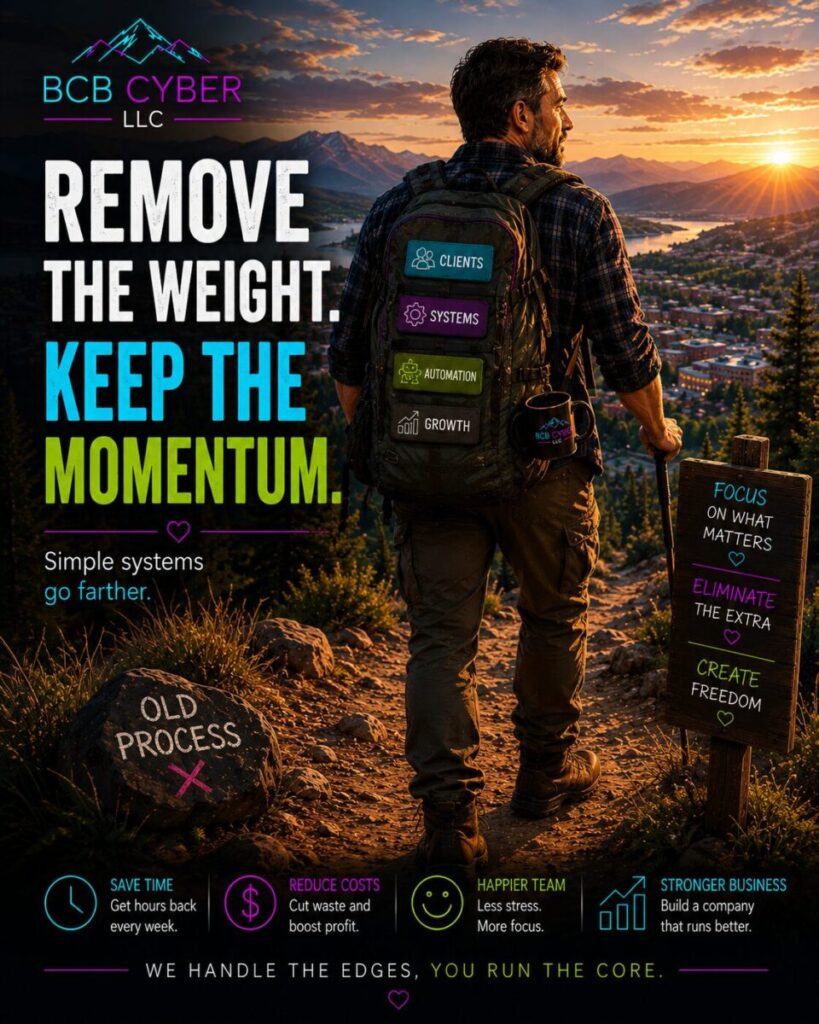
Liam’s Heavy Backpack
Monday mornings always started before sunrise. Liam preferred it that way.
The coffee shops in downtown Fort Collins had only begun filling with early commuters when he parked near Old Town, slung a weathered hiking backpack over one shoulder, and walked the quiet sidewalks toward a client’s office.
The backpack wasn’t especially large. But it looked heavy.
Years of hiking Colorado trails had taught him something most people never considered.
Weight isn’t measured by size. It’s measured by accumulation.
One extra water bottle. A camera lens. An unnecessary jacket. A few “just in case” items. None of them mattered individually.
Halfway up the trail… You felt every ounce.
Today’s client owned a growing event planning company. Business was good. The team was talented. Yet every Monday felt chaotic.
When Liam walked through the door, nobody mentioned computers.
Instead, he watched. One employee copied customer information from email into a spreadsheet. Another copied the same information into a CRM. Someone else printed the spreadsheet so another team member could handwrite notes before entering them into accounting software.
Three systems. Four people. One customer.
Liam smiled.
He’d seen this hundreds of times. He never began by installing new software. Instead, he asked one question.
“Why?”
The room grew quiet. Nobody knew. “It’s just how we’ve always done it.”
He opened his backpack. Inside wasn’t expensive equipment. A notebook. A marker. A roll of painter’s tape.
He walked to a whiteboard and drew three circles.
Email. CRM. Accounting.
Then he connected them with arrows. One by one, they eliminated duplicate steps.
No new software. No expensive project. Just removing unnecessary weight.
By lunch, the owner realized they had eliminated nearly two hours of repetitive work every day.
Nothing dramatic had happened. Nobody worked faster. Nobody skipped quality.
They simply stopped carrying things they no longer needed.
As Liam packed his backpack to leave, it felt noticeably lighter. Not because anything inside had changed.
Because another business had reminded him why unnecessary weight belongs on the trail—not inside a company.
Hidden Weight Inside Every Business
When people think about operational problems, they usually picture something dramatic—a server outage, a cyberattack, or an employee quitting unexpectedly. In reality, the biggest obstacle facing most small businesses isn’t a major event. It’s the quiet accumulation of tiny inefficiencies that slowly become part of everyday life.
Think about your own business for a moment. How many times does customer information get entered? How often do you search for a password someone forgot to document? How many emails begin with, “Just checking to see if this got done?” Every one of those moments may only take a minute or two, but together they quietly steal hours every week.
These hidden costs are rarely measured because they don’t appear on financial statements. Instead, they show up as longer workdays, frustrated employees, delayed customer responses, and the feeling that everyone is busy without making meaningful progress.
Hidden operational weight often looks like:
- Entering the same information into multiple systems.
- Using spreadsheets that no one completely trusts.
- Manually sending reminders that could be automated.
- Hunting through email threads to find customer information.
- Paying for software that only one person uses—or no one uses at all.
- Keeping paper records because “that’s how we’ve always done it.”
None of these problems are catastrophic on their own. Together, however, they create friction that affects every part of your business. Your team spends more energy managing work than completing it.
The encouraging news is that operational friction is usually easier to remove than people expect. Often, the biggest improvements come from eliminating unnecessary steps rather than adding new technology.
Why Simplicity Outperforms Complexity
Business owners are constantly being told they need another platform, another subscription, or another dashboard. The result is often a collection of powerful tools that don’t communicate with one another, creating more work instead of less.
The best businesses rarely operate this way. They focus on simplicity.
Simple doesn’t mean basic. It means every process has a purpose, every tool earns its place, and every step contributes value.
Imagine walking into a well-organized workshop. Every tool has a designated location. Every drawer has a label. Nothing is wasted searching for equipment because everything has been intentionally arranged.
Successful businesses operate in much the same way.
When systems are simple:
- Employees learn them faster.
- Mistakes happen less often.
- Customer questions are answered more quickly.
- Training becomes easier.
- Owners spend less time solving repetitive problems.
Complexity often feels productive because it creates the illusion of sophistication. Simplicity, on the other hand, requires thoughtful design. It takes discipline to remove unnecessary processes instead of continually adding new ones.
At BCB Cyber, we believe technology should quietly support your business rather than demand constant attention. The best systems are often the ones your customers never notice because everything simply works.
As the saying goes, perfection isn’t achieved when there’s nothing left to add—it’s achieved when there’s nothing left to take away.
Five Signs You’re Carrying Too Much Operational Weight
Just like an overloaded backpack makes every mile of a hike more difficult, overloaded business systems quietly slow every part of your operation. Here are five warning signs that your business may be carrying unnecessary weight.
1. You’re Entering the Same Information More Than Once
Customer names, invoices, appointments, and contact information should rarely need to be typed repeatedly. Duplicate data entry is one of the clearest signs that systems aren’t working together efficiently.
2. Your Team Relies on Memory
If employees constantly remind one another about follow-ups, deadlines, or recurring tasks, your business is depending on people instead of dependable systems. Memory is valuable—but it shouldn’t be your primary workflow.
3. No One Knows Which Spreadsheet Is Current
When multiple versions of the same document exist, confusion quickly follows. Team members begin asking, “Which file should I use?” That uncertainty creates mistakes, delays, and unnecessary stress.
4. Routine Tasks Require Constant Follow-Up
If you’re repeatedly checking whether invoices were sent, customers were contacted, or appointments were confirmed, the process itself may need improvement rather than additional supervision.
5. Every Week Feels Busier Than the Last
Growth should create opportunity—not exhaustion. When every improvement seems to add more manual work instead of reducing it, operational friction has likely reached the point where simplification should become a priority.
The goal isn’t to eliminate work. The goal is to eliminate unnecessary work.
Where to Start This Week
Improving operations doesn’t require shutting down your business for a month or investing in expensive software. Most meaningful improvements begin with observation.
This week, choose one process that your team performs every day.
Write down every step exactly as it happens. Don’t skip anything, even if it seems obvious.
Then ask yourself four simple questions:
- Why do we perform this step?
- Does it add value for the customer?
- Could this step be simplified or automated?
- What would happen if we eliminated it entirely?
You’ll be surprised how often the answer is, “We only do this because we’ve always done it.”
Focus on one improvement rather than ten.
Perhaps it’s consolidating duplicate spreadsheets into a single trusted document. Maybe it’s setting up automatic appointment reminders instead of sending them manually. It could be creating a shared checklist so no one has to rely on memory.
Small operational improvements have a compounding effect. Saving five minutes on a task completed twenty times a week creates nearly two extra hours every month. Multiply those gains across multiple workflows, and suddenly your business feels lighter, more responsive, and easier to manage.
That’s exactly what Liam’s backpack represents. The objective isn’t to become superhuman. It’s to stop carrying things that no longer belong.
Key Takeaway
Every unnecessary step steals a little energy.
Remove enough of them…
…and your entire business begins moving faster.
BCB Cyber, LLC
📚 Books • 🌐 Web • ⚙️ Systems • 🤖 Practical AI Support
Embracing Tech on the Grind
We Handle the Edges, You Run the Core.
Frequently Asked Questions
Why does my business feel busy all the time?
Because small inefficiencies accumulate until they consume hours every week.
What’s operational friction?
Anything that slows work without adding value—duplicate data entry, outdated processes, unnecessary approvals, or disconnected systems.
Do I need expensive software?
Usually not. Many businesses improve dramatically by simplifying what they already have.
What’s the first process I should review?
Choose the task your team repeats every day. That’s where the biggest gains usually begin.
How often should I review workflows?
Quarterly for most businesses, with small adjustments made whenever recurring frustrations appear.
Can automation help small businesses?
Absolutely. Even simple automations can eliminate repetitive administrative work.
Will simplifying hurt quality?
No. The goal is to remove unnecessary work while preserving or improving quality.
What’s one thing I can do today?
Write down every step involved in one routine task. If you can’t explain why a step exists, it deserves a closer look.
Why do businesses keep inefficient processes?
Because familiarity feels safer than change—even when the process no longer makes sense.