

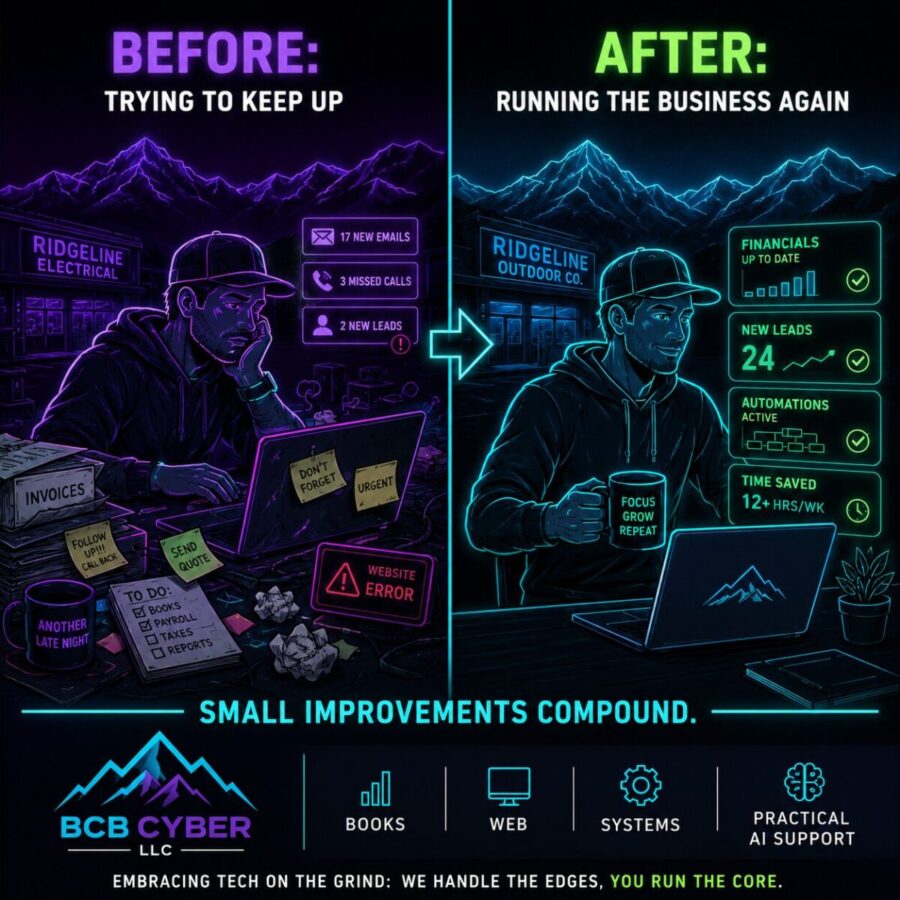

Many business owners imagine operational improvement as a massive project. In reality, most meaningful improvements start much smaller.
The bookkeeping gets organized. The website gets cleaned up. The customer follow-up process becomes consistent. An automation eliminates repetitive tasks. Individually these changes may seem minor. Collectively they transform how a business operates.
The Business Didn’t Change. The Systems Did.
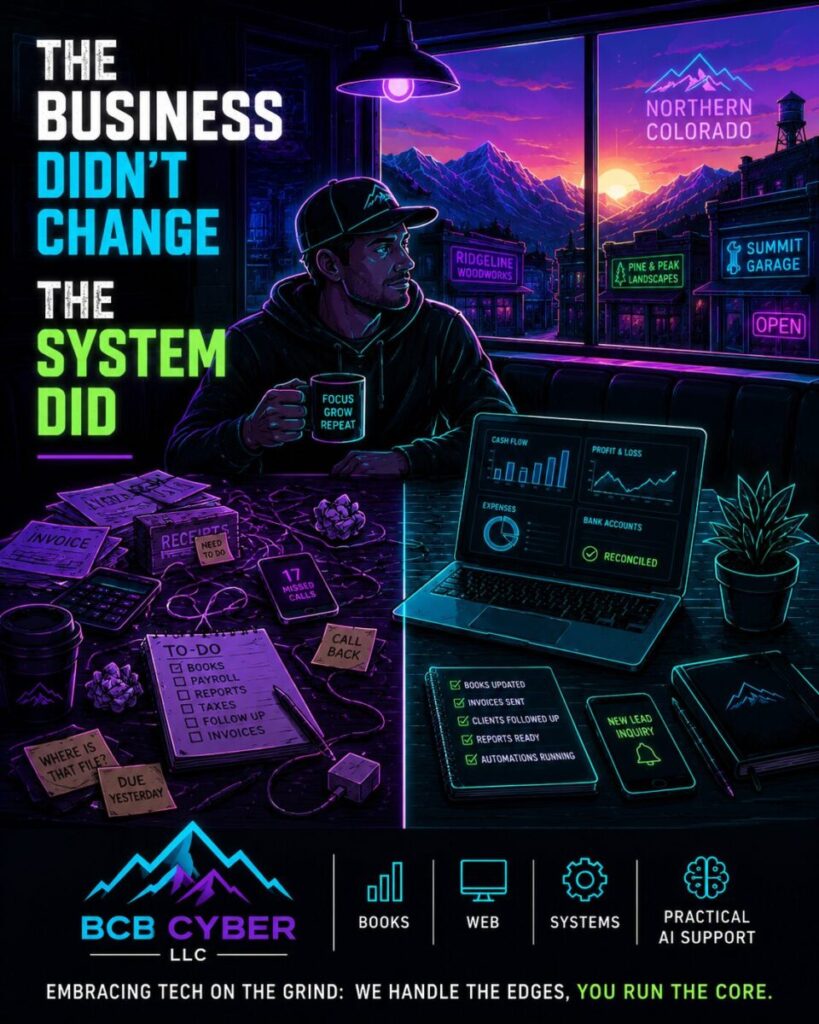
Mason sits at a neon diner booth at dawn. One side of the table is buried in invoices, sticky notes, and tangled charging cables. The other side is clean except for a laptop showing organized dashboards. Outside the window a neon sunrise breaks over a cyberpunk Northern Colorado skyline and the realization dawns that small operational systems can have a big impact on his day to day business life.
Mason’s Story, a Bright Tuesday Morning
Mason didn’t think anything was seriously wrong. His landscaping business was still getting customers. The phone still rang. Money was still coming in.
But every day felt heavier than it should. Invoices sat in one pile. Customer notes lived on sticky notes. The website contact form hadn’t been tested in months. Follow-up calls happened when he remembered them. The books were mostly accurate, but never quite current.
Nothing was broken. Yet everything seemed to require more effort than necessary.
One Tuesday morning, sitting in his favorite diner before sunrise, Mason realized something important. The business wasn’t struggling because he lacked work. The business was struggling because every small task carried unnecessary friction.
A missed lead here. A duplicate entry there. Five extra minutes on one task. Ten extra minutes on another. Individually they felt insignificant. Together they were stealing hours every week.
The Hidden Cost of Friction
Operational friction is anything that requires extra effort without creating value. Examples include double entering information, missing website inquiries, manual appointment reminders, delayed financial reporting, and repeated customer questions. These activities consume time, energy, and attention.
The Before State
Businesses experiencing operational friction often report feeling constantly behind, unclear financial visibility, inconsistent customer communication, difficulty scaling, and increased stress.
The After State
Businesses that address these bottlenecks often experience better visibility into finances, faster customer response times, improved consistency, reduced administrative workload, and more confidence in decision-making.
Focus on the Next Improvement
The goal is not perfection. The goal is reducing unnecessary effort.
The next operational improvement may only save ten minutes per day. But over a year, those small gains become substantial.
Back to Mason
A few months later, Mason still owns the same business. He still answers customer calls. He still visits job sites. He still works hard.
What changed wasn’t the business. What changed was the system supporting it. The books are current. The website works the way it should. Customer inquiries no longer disappear into the void. Routine tasks happen automatically instead of relying on memory.
Most importantly, Mason ends more days feeling like he’s running the business instead of chasing it. That’s the real goal of operational improvement. Not perfection. Not complexity. Just removing enough friction that you can focus on the work that matters most.
BCB Cyber, LLC
📊 Books • 🖥️ Web • ⚙️ Systems • 🧠 Practical AI Support
Embracing Tech on the Grind: We Handle the Edges, You Run the Core.
Frequently Asked Questions
What is operational friction in a business?
Operational friction refers to unnecessary effort caused by inefficient processes, outdated systems, manual work, or inconsistent workflows.
How do bookkeeping improvements help a business?
Clean bookkeeping provides better financial visibility, faster reporting, and improved decision-making.
Can website improvements increase leads?
Yes. Faster websites, clear calls to action, and working contact forms can improve lead generation and customer engagement.
What types of business tasks can be automated?
Appointment reminders, lead follow-up, customer communication, internal notifications, and reporting are common automation opportunities.
How do I know where to start?
Look for the task that creates the most frustration or consumes the most repetitive time each week.
Are small operational improvements worth it?
Absolutely. Small improvements often compound into major gains in efficiency over time.