

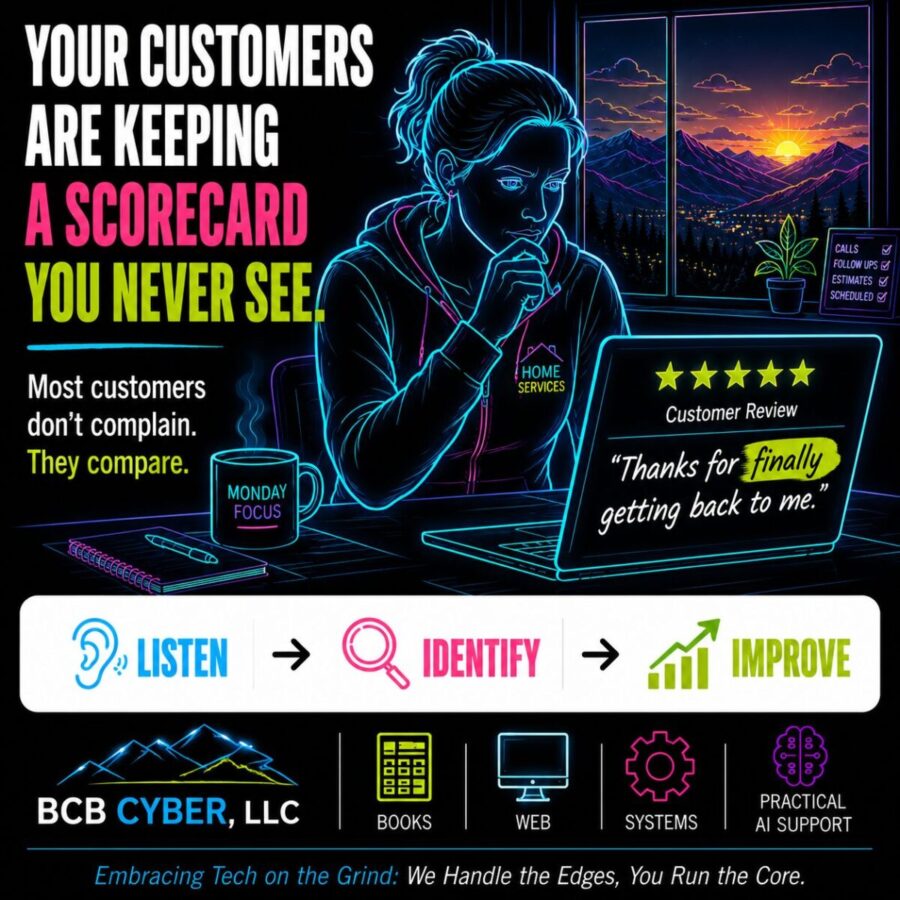

A review caught my attention recently. Five stars. Happy customer. Everything looked positive. Then I noticed one sentence:
“Thanks for finally getting back to me.”
At first glance, it felt like a compliment. And it was. But it was also something else. A clue.

The Hidden Message Inside Positive Feedback
Most business owners see the five stars. What customers often reveal is hidden inside the words. That single sentence told me something important. The customer was happy, but they also remembered waiting.
The experience ended well. The journey wasn’t completely smooth. And that’s the part many businesses miss.
Customers Notice Different Things Than Owners
One challenge every business owner faces is perspective. Owners see projects, schedules, tasks, workflows, and priorities.
However, customers see responsiveness, convenience, clarity, communication, and trust.
Neither perspective is wrong. But they are very different.
A Common Northern Colorado Business Pattern
Whether it’s a contractor in Loveland, a wellness practice in Fort Collins, or a service company in Greeley, one thing appears consistently.
Business owners often focus on the outcome. Customers often remember the experience.
A project can be completed perfectly. A service can be delivered successfully. Yet customers still remember how long they waited, how easy communication felt, whether their questions were answered, and how confident they felt throughout the process.
Those details become part of the scorecard.
The Most Dangerous Phrase In Business
One phrase sounds reassuring but often isn’t:
“Nobody has complained.”
Because most customers don’t complain. They compare.
They compare your responsiveness to another business. They compare your communication to another provider. They compare your experience to their expectations. And then they make a decision.
Quietly.
The Clues Are Everywhere
The good news is that customers often leave clues; in reviews, emails, conversations, survey responses, and phone calls.
Sometimes the clues appear as praise. Sometimes they appear as questions. Sometimes they appear as repeated comments.
The businesses that improve consistently learn how to listen for them.
What Building BCB Cyber Keeps Teaching Me
One lesson I keep relearning is that customers experience the business very differently than I do.
I naturally focus on systems, websites, processes, and workflows. However, my customers focus on trust, clarity, responsiveness, and confidence.
The technical work matters.
But the customer experience is what people remember.
The Better Question
Instead of asking:
“Did anything go wrong?”
Try asking:
“What did customers notice?”
Those answers are often far more useful. Because customers frequently identify friction before owners ever realize it exists.
Final Thought
The customer who leaves a review is doing more than sharing an opinion. They’re showing you how the business feels from the outside. And that’s a perspective no dashboard can fully provide.
The businesses that grow consistently aren’t always the ones with the best systems. They’re often the ones paying attention to the scorecard customers are already keeping.
Even when nobody talks about it directly.
Today’s Tiny Framework:
LISTEN
↓
IDENTIFY
↓
IMPROVE
BCB Cyber, LLC
📊 Books • 🖥️ Web • ⚙️ Systems • 🧠 Practical AI Support
Embracing Tech on the Grind: We Handle the Edges, You Run the Core.
Frequently Asked Questions
What is a customer scorecard?
Minimalist neon-outline home services business owner reviewing a customer review and realizing that positive feedback can still contain hidden operational lessons.
Why don’t customers always complain?
Many customers prefer to move on rather than provide negative feedback.
What is customer friction?
Customer friction is anything that creates confusion, delays, inconvenience, or uncertainty during the customer experience.
Why are reviews important?
Reviews often reveal what customers actually notice and value about your business.
What can positive reviews teach us?
Positive reviews frequently contain clues about operational strengths and weaknesses.
How do I identify customer friction?
Look for recurring comments, repeated questions, delays, or points where customers require extra assistance.
What causes customers to leave quietly?
Confusion, slow responses, uncertainty, and poor experiences often lead customers to choose alternatives without providing feedback.
Why is response time important?
Customers often interpret response speed as a reflection of reliability and professionalism.
What role do systems play in customer experience?
Strong systems help create consistent, reliable experiences and reduce avoidable friction.
What’s the biggest lesson from customer feed back?
Customers often notice operational issues long before business owners do.